I. The origin of the breed of Chartreux cats
During the Crusades there were some CHARTREUX cats introduced into France. 1920s, French breeding experts crossed CHARTREUX cats with Persian cats, and the official breeding program was not introduced until 1926. 1926, the two sisters surnamed LEGER began to wander around with the French MORBIHAN place BELLE-ILE-SUR-MER In 1926, two sisters, surnamed LEGER, began to breed the blue cats with the rendered blue cats that roamed around in Belle-ile-Sur-Mer, Morbihan, France. After defining their physical characteristics, Dr. JUMAUD (1930) named these cats FELIS CATTUS CARTUSINORUM.
II. Introduction of the breed of Chartreux cats
The breed was publicly displayed at the Cat Club of Paris in 1931. The first breed standard was published in 1939, and in the 1960s and 1970s, the breed was crossed with the blue British Shorthair so frequently that in 1970 FIFe merged the two breeds. Was the CHARTREUX cat breed destined to disappear? SIMONNET, the president of the CHARTREUX Cat Club, provided FIFe with strong evidence of the authority of the breed, which led to the decision to separate the two breeds and forbid them to continue to interbreed. The first CHARTREUX cat was introduced into the U.S. in 1970, and both the CFA and TICA recognized the breed.
- Chartreux morphological characteristics
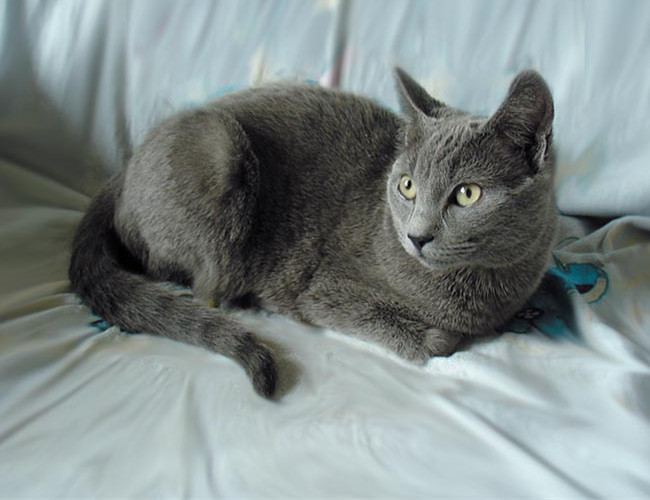
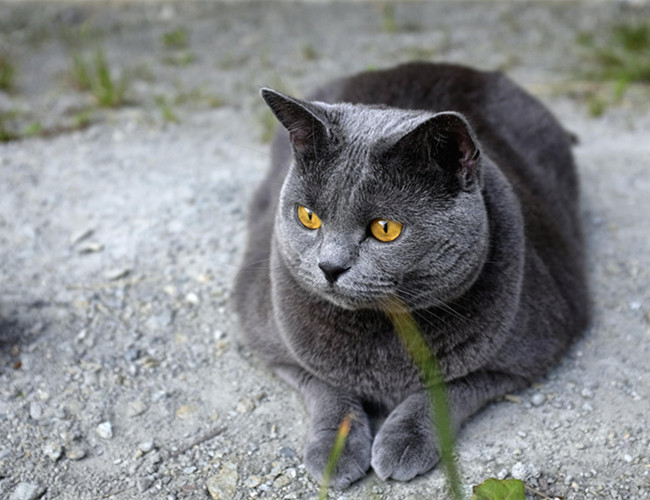
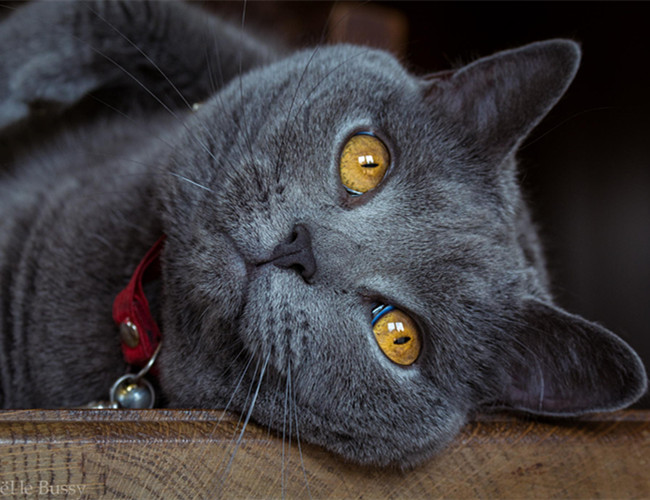
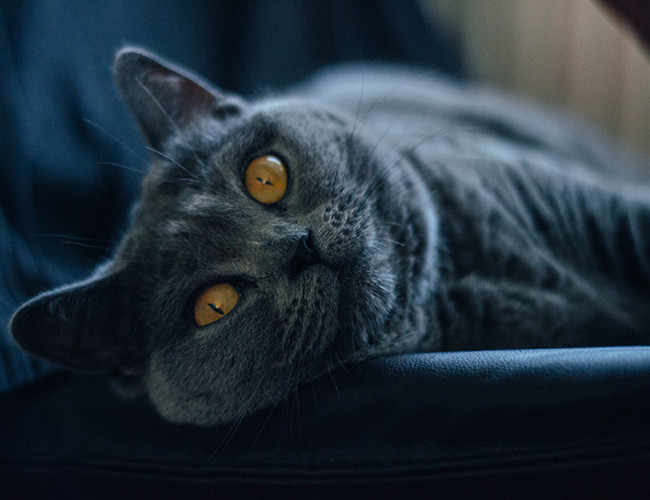
The Chartreux is a slightly chubby cat with a blue-gray coat, which is the most distinctive feature of the Chartreux. Its elastic blue-gray coat is thick and soft, and shines beautifully, making it an attractive short-haired cat with a slightly longer coat. The Chartreux has a slightly rounded head with a pair of bulging cheeks and round, bright golden eyes with a lot of expression.
Chartreux Cat’s morphology
Head: Wide and round, not spherical, like an inverted trapezoid. The skull is not hemispherical, slightly rounded, and the area between the two ears is flat. The cheeks are plump, round and low, and adult male cats have large double chins. The nose is straight and wide, not turned upward. A slight nasal break is acceptable, but a nasal break is discouraged. The connection between the muzzle and head is flat and straight, tapering toward the end but not pointed. The moustache mats are large and the cheeks and chin are clearly demarcated, resulting in the unique smile of this breed of cat. The chin is strong, especially in male cats over two years old.
Ears: Small to medium-sized. Highly positioned. Vertical, rounded ear tips. Narrow at the base.
Eyes: Large and round, with the outer eye tips sloping upward. Color: Orange to gold. No admixture of green or lighter colors in the side.
Neck: Short and stout. The body is strong and sturdy, especially in male cats. Broad shoulders and thick chest. Straight back. Strong bones. Dense muscles.
Legs and claws: Straight, short to medium length, strong and very muscular. Small, round, wide claws.
Tail: Medium length. Thick at the back, tapering slightly toward the tip, with a rounded tail tip.
Coat: short, thick, extremely dense (with Mizuse fur), glossy, slightly woolly, waterproof, standing up erect because of excessive undercoat fuzz. Color: Any blue color, from soot to slate gray is acceptable, but bright blue is preferred. Consistency of color is key. The snout is slate gray and the foot pads are rose gray. Skin is blue. Kittens are born with birth moles, but these fade by 6 months to a year of age. The orange color of the eyes does not appear and replace the blue-gray eye color often found in kittens until 3 months of age. Green eye color, dull or faded eye color. Coat: White locks. Hair tip coloring, birthmark streaks or variation in coat color. Brown or red for heavy coloration.
- Chartreux character traits
Chartreux cats are physically robust and not only have great endurance, but can also adapt to a variety of different environments. The character of the Chartreux is gentle, well-behaved and educated. It is easy to get close to people and will show its love and devotion to its owner. It is understandable that the cat will be wary of people or animals it has never seen before, because cats are originally timid animals, but if you can be gentle and patient with it, the cat will be very friendly with you in a while!
Chartreux cats are docile, easy to get along with, independent, strong personality, but not often used voice. Affectionate and heartfelt to its owner. Conservative, likes to be alone and quiet. Strong, hardy and vigorous, very well adapted to cold outdoor survival. Chartreux cat (details) is physically strong, has great endurance, and can adapt to a variety of different environments. Gentle personality, very well-behaved and well-bred. It is easy to get close to people and will show its love and devotion to its owner. Although it is wary of strangers, it will not attack people, and if you can treat it gently, it will quickly get close to you.

- Chartreux cat care knowledge
One of the daily care given to Chartreux cats, deworming, must be essential. There are cats that have never been vaccinated even in their life, but are still healthy and resistant to viruses as well, why is that? First of all, the cat must be a big cat over one year old! There is absolutely no way that it could be a kitten under four months old. Because the virus is unimaginably lethal to unvaccinated kittens under four months! And big cats in the process of his growth itself will gradually adapt to the environment, the production of antibodies, which is also the same reason as people have their own immunity. Just like the same kind of disease, such as a viral cold, etc., adults may fight it off in a few days, but it’s more dangerous for a few months old!
The care of Chartreux cats
1. For newly born kittens they get their antibodies from their mother. At the time of their birth, the mother cat gives them enough antibodies to enable them to grow up healthy, just as human colostrum contains many antibodies necessary for newborns. However, since their exposure to the environment is still short and their bodies are not yet able to produce antibodies on their own, these antibodies will gradually fade away after two months, i.e. after weaning, so it is important to immunize them in time to help them resist viral diseases at around 10 weeks. It is the same reason that immunization should be started a few months after the birth of a child. For example, if a simple enteritis is left untreated, it can turn into a viral infectious enteritis if various pathogenic bacteria take advantage of the opportunity to invade, which is very dangerous. This is the same as a pediatric cold that may turn into pneumonia with dangerous consequences if left untreated. Therefore, it is very important to immunize kittens at around 10 weeks!
2. After the first vaccination, it does not act as an immunization, it only serves to generate a signal in the cat’s body so that the cat’s own immune system can recognize the virus and identify it. The second vaccination is what really builds up the immune protection system against viral epidemics and helps the cat resist the virus! And the antibodies are not immediately available, and the immunity is not really there until 7 to 10 days after the second vaccination!
This is why it is imperative to get vaccinated twice! In some places abroad it is vaccinated three times, for the same reason, just more insurance. For the big cats after one year old only need to be vaccinated once a year can be, the same reason and people, we grow up as a child vaccination is much more!
- Chartreux cat feeding requirements
If you have a Chartreux cat at home, do you take good care of your cat when you are busy with your work life? Chartreux cat is slightly obese, which is also its characteristic, but it can not be given indiscriminate food, human food, dog food, snacks at home, are all taboo, not to mention the overeating. Only to the Chartreux cat’s diet balanced nutrition will not have disease to find, please cat lovers must pay attention!
Chartreux cat’s
1、Guarantee the quality of food
It is best to buy from the pet hospital to ensure the quality of the product, or supermarkets can also accept it. Never go to the food market to buy, where the cat food is indeed cheap, but, the raw materials are plants, Chartreux cats eat a long time will get heart disease, or more serious diseases. Cats are carnivores, the ingredients must be meat and the necessary nutrients added.
2、The selection of taste
There are many brands of cat / dog food on the market have flavors, such as “beef flavor”, “chicken flavor” and so on. When pet food labels are labeled as containing “beef” or “chicken”, but how much beef or chicken is in it? The list of ingredients in professional pet food is arranged in descending order of weight. For example, if chicken is first on the label list, it means that chicken is the main ingredient in the pet food, and the content is higher than other ingredients. If a cat food says “chicken flavor” but the ingredient ratio behind it does not have chicken in the first place, it proves that the cat food is not high in chicken.
It is normal for pets to prefer a particular flavor, but it is best for owners to change the flavor or mix the flavors for their pets on a regular basis. This will avoid picky eating. There is also the fact that you won’t have your hands full when this flavor of food is out of stock.